


RECONMATIC Open Day in Beijing: Advancing Automated Solutions for Circular Construction

On 30 March, the final RECONMATIC Open Day in China was successfully held in Beijing. Representatives from government bodies, research institutions, and industry across China and Europe gathered to exchange insights on innovative approaches to construction and urban solid waste management.
From Data Gaps to Lifecycle Management
A key focus of the RECONMATIC project is the use of digitalisation to accelerate the circular transition of construction and demolition waste.
On the Open Day, Jakub Ducár from STRABAG introduced the WASTEie standardised dataset and its integration with the Materials Data Bank. Built on openBIM principles, this approach creates a shared digital language that enables material information to be tracked consistently from design through to demolition. By addressing fragmentation and data loss across the lifecycle, the solution allows stakeholders to share structured data and significantly improve material reuse rates.

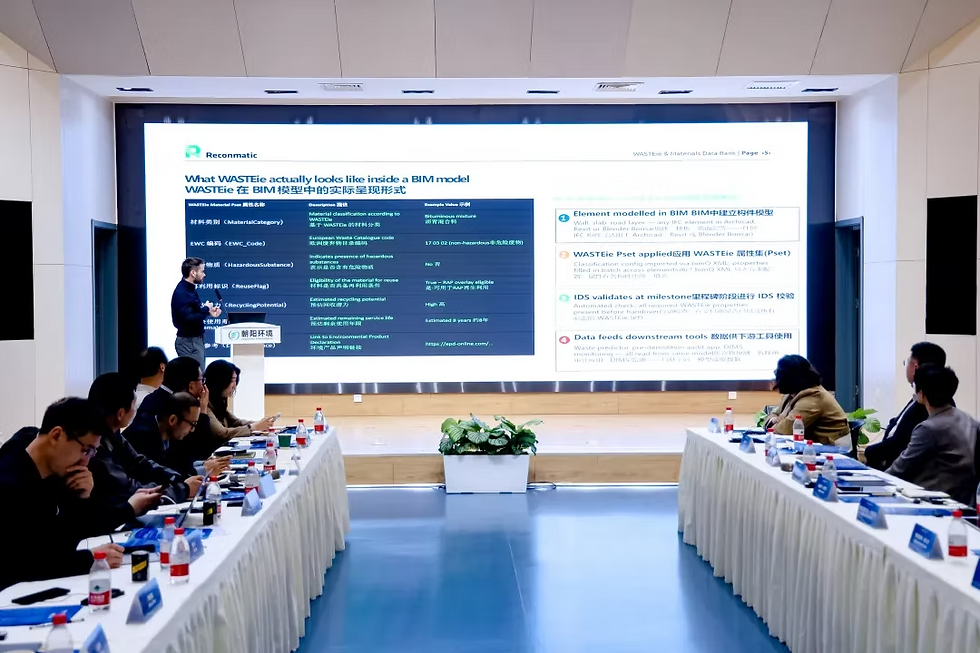
Stanislav, also from STRABAG, demonstrated how digital tools can transform pre-demolition audits. Using RECONMATIC’s framework and digital-twin technology, traditional manual surveys that once took days can now be completed in minutes. This enables more accurate identification of materials and hazards, supporting efficient logistics planning and more effective resource recovery.


Building a Cross-Border Circular Construction Ecosystem
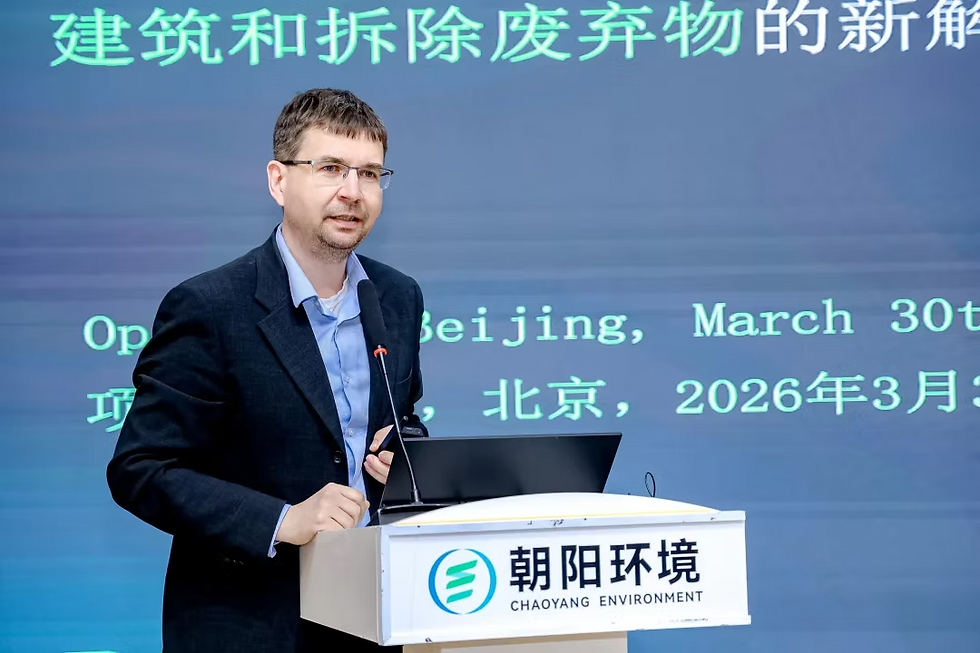
Professor Jan Valentin from the Czech Technical University in Prague, coordinator of the RECONMATIC project, presented an overview of the initiative. As a collaborative effort between the EU, the UK, and China, RECONMATIC aims to address the global challenges of construction waste through a lifecycle-based approach, targeting up to 80% material reuse.
By combining BIM data standards, digital twins, robotic sorting, blockchain tracking, and Cloud2BIM technologies, the project is developing an integrated and scalable system for circular construction, supporting the transition towards a low-carbon built environment.
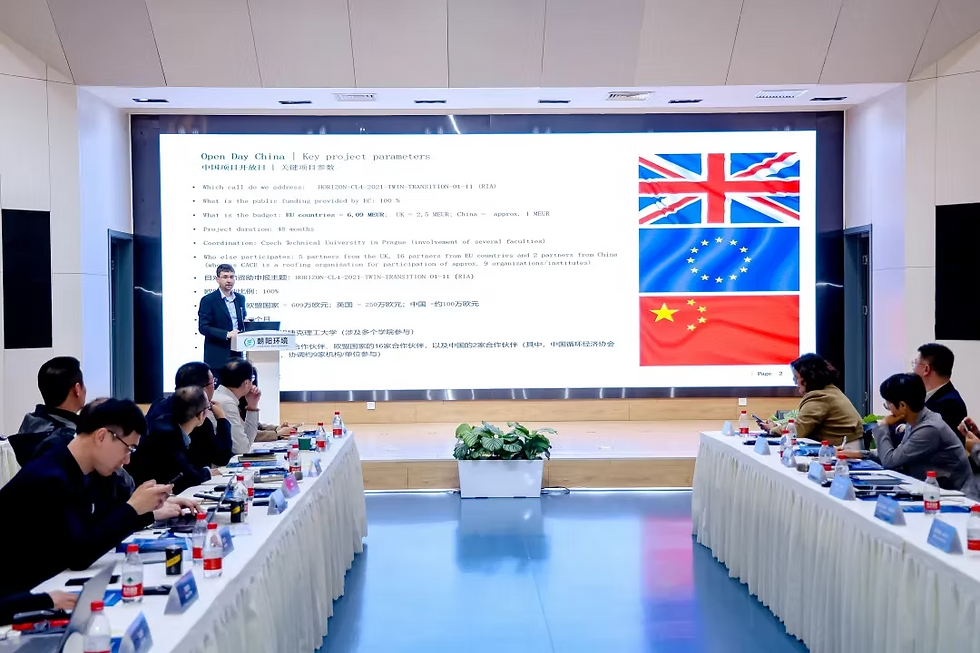
Ma Shujie from the China International Engineering Consulting Corporation also provided an update on China’s latest policies on integrated construction waste management, highlighting future opportunities for international collaboration, particularly in digitalisation, AI, and automated sorting technologies.

AI-Driven Waste Management in Practice
The event concluded with a site visit to the Beijing Chaoyang Circular Economy Industrial Park, hosted by Pi Meng, Chairman of Beijing Chaoyang Environment Group, and Zhao Kai, Executive Vice President of the China Association of Circular Economy.


A key highlight was the AI-powered smart incineration system, which enables real-time monitoring and intelligent control of waste-to-energy processes. The system has significantly improved operational stability and efficiency, while reducing energy consumption and manual workload—demonstrating the practical potential of integrating AI into environmental infrastructure.
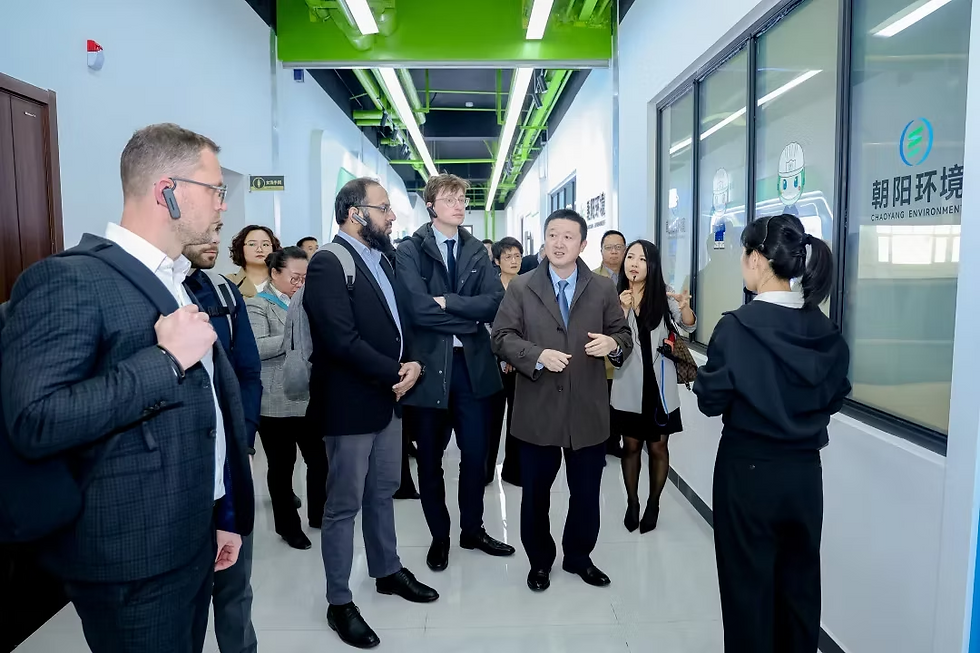
More broadly, the park showcases an integrated approach to waste management by combining waste incineration, food waste treatment, and construction waste processing. This enables cascading energy use and resource recovery, forming a highly efficient circular system that is considered a leading model both in China and internationally.
As the final RECONMATIC Open Day held in China, this event marked an important milestone for the project. It provided a platform to showcase key technological achievements, share policy developments, and strengthen collaboration between China and Europe in advancing circular construction.
This article was authored by Arcas & Callisto Consulting (A&C), and published on the 17th of April 2026.


