


Infographic: Where Are the Women in Construction STEM?

Construction today is changing fast. It’s becoming more digital, more climate-focused, and more science-driven than ever before, especially as Europe moves toward circular construction, where materials are reused, waste is reduced, and buildings are designed for long-term value.
And yet, when it comes to women in STEM roles in construction, the situation still feels like an empty page, a tiny dot of visibility in a huge sector.
This is exactly why RECONMATIC is launching this campaign: to raise awareness, challenge outdated stereotypes, and show that STEM careers in circular construction are real, impactful, and accessible.
The reality: construction is still a male-dominated sector
Let’s start with the numbers. Construction remains one of the most male-dominated sectors in Europe. Women represent only around 10% of the construction workforce, while around 90% are men (European Commission, 2023).
That gap is not a detail. It shapes workplace culture, career pathways, leadership representation, and the stories young people hear when they imagine their future.
But what’s even more important is what happens when we “zoom in” on that 10%.
Even within that 10%, STEM roles are still rare
Yes, women are present in construction, but they’re often concentrated in roles such as administration, support, or management.
When it comes to STEM and technical positions, women are still significantly underrepresented (Green Circle, 2024). So the headline statistic doesn’t tell the full story.
If women are only 10% of the workforce, and only a small share of that 10% is in STEM - then women in technical construction roles become almost invisible.
And visibility matters, because it affects everything:
who is seen as “belonging” in the sector
who feels encouraged to apply
who gets mentorship and opportunities
who becomes the next generation of researchers, innovators, and leaders
Download the infographic
If you’d like a visual overview of the data, the challenge, and the STEM opportunities in circular construction:
Use it to spark conversations in:
classrooms
career guidance sessions
policy and education discussions
STEM outreach initiatives
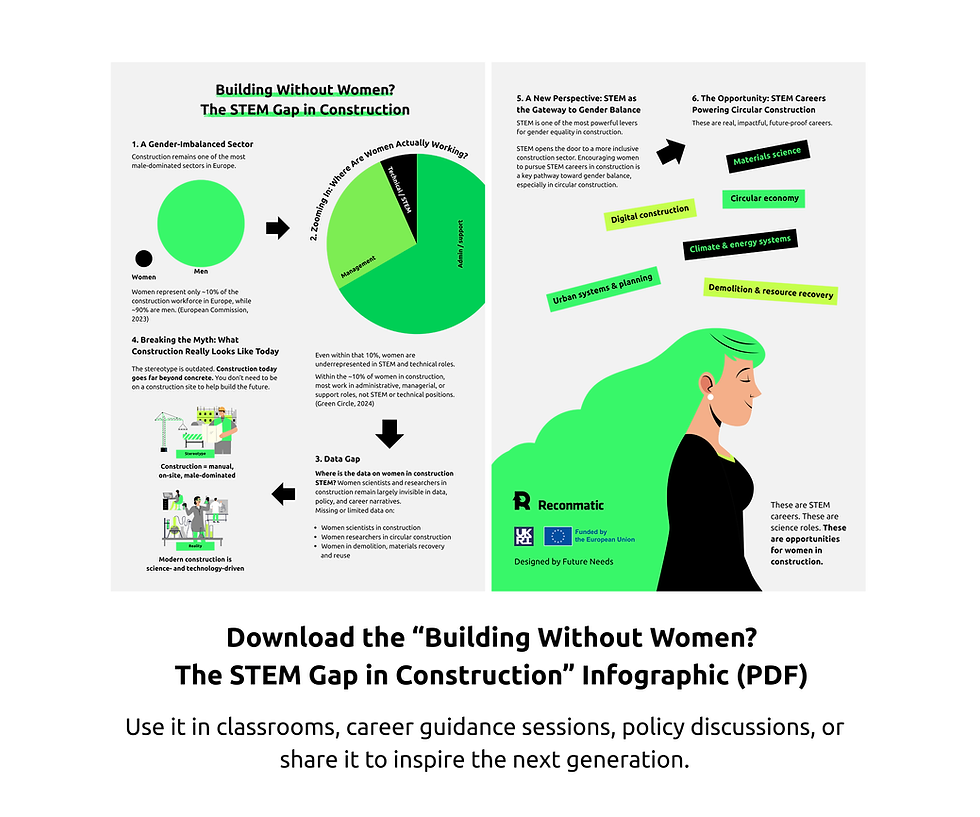
The biggest problem is also the quietest one: the data gap
Here’s a question we should all be asking: Where is the data on women in construction STEM? In many cases, it’s missing, limited, or fragmented.
Women scientists and researchers in construction are often invisible in:
datasets
policy discussions
career narratives
public representation of the sector
And when certain roles are invisible in data, they tend to become invisible in strategy too.
That includes women working in some of the most important areas for circular construction, such as:
materials recovery and reuse
demolition audits and circular planning
low-carbon materials research
circular design and digital construction tools
The stereotype is outdated, and it’s holding the sector back
One of the reasons gender imbalance persists is that many people still think construction only means physical, on-site work. But modern construction is much broader than that.
Today, construction includes people working:
in laboratories analysing materials
in research teams developing low-carbon solutions
on BIM models and digital tools
on geospatial analysis for resilient cities
on climate and energy systems
on strategies for reuse, resource recovery, and circular design
Circular construction is not “just building.” It’s science + technology + sustainability, and it needs diverse talent to succeed.
STEM is one of the strongest gateways to gender balance in construction
If we want construction to become more inclusive, one of the most powerful levers is clear:
STEM. STEM careers open doors into the technical roles where the sector is evolving fastest, and where circular construction is being shaped every day.
Encouraging women to pursue STEM pathways connected to construction isn’t about “fitting women into a male sector.” It’s about transforming the sector into something better: more innovative, more inclusive, and more aligned with the realities of sustainability.
The opportunity is real. Circular construction is creating future-proof careers in areas like:
Materials science
Circular economy & resource efficiency
Digital construction & BIM
Climate & energy systems
Urban systems & resilience
Demolition, reuse & resource recovery
These are not “support roles.” These are innovation roles. And they are exactly where the future of construction is being built.
Real voices from RECONMATIC: women shaping the future of construction
Katerina Karanafti (Aristotle University of Thessaloniki)
Civil Engineer and PhD candidate
“As a Civil Engineer and PhD candidate focusing on buildings’ energy efficiency, I am driven by the challenge of developing adaptive building envelopes that make our cities more resilient and energy efficient.”
Her work is a great example of what construction STEM really looks like today: research-driven, climate-relevant, and directly connected to the way our cities will function in the future.
Inés Díez Ortiz (TECNALIA)
Researcher focused on the valorisation of construction materials
“I am a researcher focused on the valorisation of construction materials. During my studies in chemistry and my master’s degree, my main interest was environmental science, especially the marine environment, but life sometimes leads you down unexpected paths… I am currently discovering how a key sector such as construction plays an essential role in preserving the environment and exploring how it can evolve towards more circular practices is extremely interesting to me… Learning from colleagues who have experienced the sector from a more traditional perspective and have witnessed its evolution is truly enriching.”
Her story matters because it breaks another myth: that there’s only one “type” of person or one “type” of path that leads into construction.
Silvia Fernández Marín
PhD in Architecture, Technical Director at AEICE – The Efficient Habitat Cluster
“I chose this field not only to design buildings, but to focus on research and innovation, combining science, technology, and creativity to develop better solutions for our cities and the built environment.”
Her perspective highlights how modern construction is no longer just about structures, it is about interdisciplinary innovation that blends science, technology, and creativity to reshape the built environment.
Mónica Vicent Cabedo
Researcher, Materials and Ceramic Technologies Area, Focusing on low embodied carbon materials, ITC-AICE
“There is no planet B. I am working on obtaining building materials from wastes (without using virgin raw materials) and building materials with low environmental impact, with a considerable reduction in process energy and greenhouse gas emissions.”
Her work demonstrates how circular construction starts at the material level, reducing emissions, rethinking raw resources, and designing building materials aligned with climate responsibility.
María Isabel De La Cruz Luis
Architect and researcher in urban resilience, ICATALIST
“As an architect and researcher in urban resilience, I work closely with the construction and built environment sector. I chose this career because buildings and cities play a key role in addressing climate change and social inequalities. My work focuses on integrating geospatial analysis with design and planning to foster more resilient, efficient, and sustainable urban development.”
Her research shows how construction intersects with climate adaptation, urban planning, and social equity, proving that resilient cities are built through data, science, and long-term vision.
A sector that wants to build the future must include the people who will live in it
Circular construction is one of Europe’s key pathways toward climate goals and resource efficiency. But progress doesn’t happen with technology alone. It happens with people, and the sector cannot afford to miss out on talent.
If young women don’t see themselves represented in construction STEM, they’re less likely to consider it. If the data doesn’t show them, strategies don’t include them. If narratives don’t highlight them, the stereotype stays stuck in place.
That’s why RECONMATIC is making women in construction STEM visible, not just as an equality goal, but as a necessary condition for innovation.
This article and the infographic were developed by Future Needs, leading dissemination activities for the RECONMATIC project.


